🍪 We use cookies
We use cookies to enhance your experience, analyze site traffic, and for marketing purposes. By clicking "Accept All", you consent to our use of cookies. Read our Privacy Policy


Learn when passive treatment can be useful for short-term pain relief without creating dependency, and why movement should stay at the center of recovery. Discover practical hands-on approaches for the low back that support relaxation, reduce fear, and open a clear path into rehabilitation.
Rethink posture and core training through a modern pain-science lens: posture matters most when it changes symptoms, not because there’s one “perfect” way to move. Discover why movement variability, symptom modification, and the right balance of stiffness and freedom can be more powerful than rigid stability drills.
Learn how limited hip mobility, weak abdominals, and overactive muscles can drive low back and hip pain—and why the body often compensates in the lumbar spine. Discover key movement patterns, clinical tests, and targeted exercise strategies to restore hip function, glute activation, and spinal control.
Discover how a clinician’s words can either fuel fear or build safety, trust, and recovery. Learn why listening fully, choosing language carefully, and reinforcing confidence can transform how people understand pain and regain control.
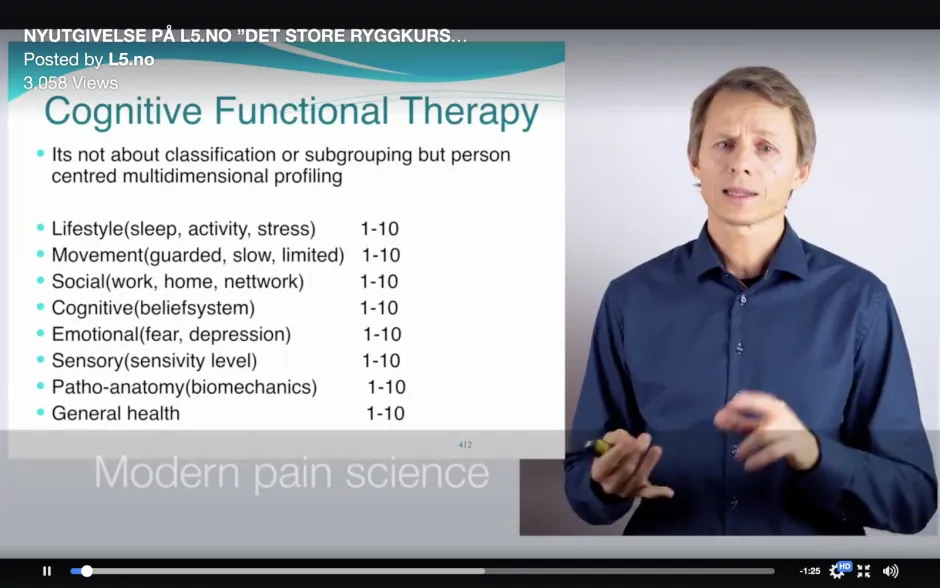
Discover how cognitive functional therapy reframes low back pain by looking beyond the spine to fear, beliefs, movement habits, lifestyle, and overall health. Learn why relaxation, breathing, and guided pain-free movement can restore confidence, reduce guarding, and help people move with less pain.
Learn how to recognize lumbar extension patterns that drive back pain, from excessive lordosis and anterior pelvic tilt to poor hip-spine control. Discover practical strategies to reduce symptoms by improving abdominal and glute activation, restoring movement balance, and avoiding painful extension habits.
Discover how evidence-based practice balances research, clinical expertise, and patient preferences to guide better decisions. Learn why effective care means finding the real drivers behind each person’s pain and delivering the right treatment at the right time.
Explore a practical, less threatening way to understand lumbar spine movement by distinguishing between guarding and directional sensitivity, while keeping psychosocial factors in view. Learners will see how small movement changes, hip retraining, and symptom modification can reduce pain and build confidence in everyday tasks.
Discover how movement patterns shape muscle function far more than isolated muscle strength, and why “tight,” “short,” “weak,” or “overactive” aren’t always what they seem. Learn to spot key imbalances around the spine, pelvis, and hips—and how smarter strategies can improve mobility, control, and pain.
Explore a modern, evidence-informed approach to low back pain that goes far beyond structure alone, combining pain science, the biopsychosocial model, movement, and hands-on care. You’ll discover how fear, beliefs, lifestyle, and loading shape pain—and how to guide recovery with clearer reasoning and greater confidence.
Discover how the biopsychosocial model explains back pain as more than tissue damage, linking physical, psychological, and social factors into one whole-person approach. Learn why fear, stress, sleep, beliefs, and lifestyle can drive pain just as much as biomechanics—and how better screening and communication can change care.
Learn why rotation-related back pain often starts with limited hip motion and excess movement in the lumbar spine, and how signs like TFL dominance, pelvic asymmetry, and daily movement habits contribute. Discover simple, functional strategies to improve hip rotation, stabilize the pelvis, and reduce pain in walking, exercise, and sport.
Learn how to recognize and manage gluteal and proximal hamstring tendinopathy by linking pain patterns, movement habits, and key clinical tests. Discover which rehab strategies reduce compression, restore strength, and guide a gradual return despite often slow recovery.
Learn how pelvic girdle pain in pregnancy is identified, what shapes recovery, and why reassuring, evidence-based guidance matters more than fear-driven explanations. Discover practical assessment and rehabilitation approaches that build confidence, reduce sensitivity, and support a safe return to normal movement.
Discover why MRI and X-ray findings often fail to explain low back pain—and how poor communication can increase fear, dependence, and even unnecessary surgery. Learn when imaging matters, when it doesn’t, and how to build confidence through informed, evidence-based care.
Discover why low back pain surgery is often overused, when it may truly be necessary, and why rehabilitation, movement, and lifestyle changes should come first. Learn how to identify the real drivers of pain and choose the right treatment for the right patient at the right time.
We usually answer within a minute.
Ask anything about your membership, certificates or what is in the library.
No comments yet…