🍪 We use cookies
We use cookies to enhance your experience, analyze site traffic, and for marketing purposes. By clicking "Accept All", you consent to our use of cookies. Read our Privacy Policy


The first lecture takes you through the epidemiology of PFP, considering the reported incidence and prevalence of the condition in different populations. The factors that are commonly associated with its development and persistence are presented.
The second introduces an approach to assessment of anterior knee pain, guiding the viewer through the deductive reasoning approach to achieve a diagnosis of PFP. This lecture contains a practical demonstration of how you might start to exclude other possible differential diagnoses of the anterior knee.
The third lecture presents the optimal approaches to rehabilitating an individual with PFP. How to tailor your intervention to achieve the optimal outcome dependent on the specific deficits that a patient presents to you with in clinic.
The fourth takes the viewer through the concepts of movement retraining and offers easily applied tips on how this can be implemented to runners with PFP.
The fifth and final lecture briefly presents the role of adjuncts in the management of PFP. How these simple tools can be used in the clinical setting to modify patients pain ands help optimise adherence to physical therapy management plans.
In addition to these lectures, 3 short, patient education videos have been developed. These can be used to help you to educate your patients on PFP. One talks about why their knee cap hurts, the second on how to start rehabilitation exercise and the third on what other treatment options (other than exercise) are there.
We hope that you find the lectures enjoyable and informative. We are more than happy to be contacted via email or SoMe if you have any questions or comments.
Explore how patellofemoral pain is defined, diagnosed, and why it affects far more than just the area behind the kneecap. Learn what current research reveals about prevalence, key risk factors, and which long-held assumptions about cartilage, sex, age, and alignment may be misleading.
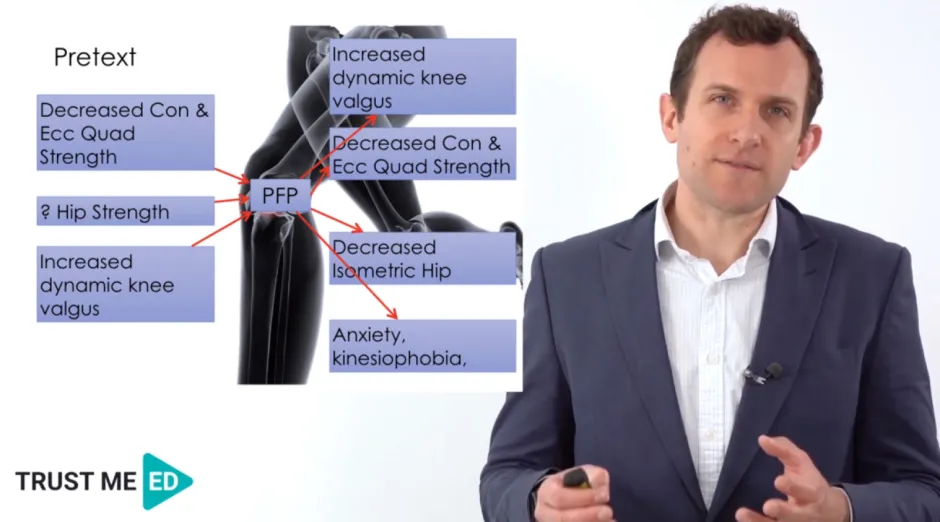
Discover why patellofemoral pain must be diagnosed by first ruling out other sources of anterior knee pain, then treated by targeting the real deficits driving symptoms. You’ll learn a practical framework built around structure, biomechanics, training load, and psychosocial factors to guide smarter assessment and rehabilitation.
Discover how running retraining can reduce patellofemoral pain by changing technique, not just building strength. Learn why step rate, feedback, and individualized cues may improve symptoms and function, while also revealing the limits, risks, and real-world challenges of applying these strategies.
Learn a practical step-by-step approach to assessing anterior knee pain by ruling out key pain sources, from the patellar and quadriceps tendons to Hoffa’s fat pad, menisci, and cruciate ligaments. You’ll also see how targeted palpation and provocation tests can help identify patellofemoral pain with greater confidence.
Discover how foot orthoses and patella taping can play a valuable short-term role in managing patellofemoral pain, and why careful clinical reasoning matters more than rigid debate. Learn which simple tests can help predict who is most likely to benefit.
Discover how to make patellofemoral pain rehabilitation more precise, effective, and lasting by matching exercise to each person’s specific deficits. Learn why quadriceps and hip training matter, how to progress through key rehab phases, and how to improve outcomes while respecting pain and adherence.
The first lecture takes you through the epidemiology of PFP, considering the reported incidence and prevalence of the condition in different populations. The factors that are commonly associated with its development and persistence are presented.
The second introduces an approach to assessment of anterior knee pain, guiding the viewer through the deductive reasoning approach to achieve a diagnosis of PFP. This lecture contains a practical demonstration of how you might start to exclude other possible differential diagnoses of the anterior knee.
The third lecture presents the optimal approaches to rehabilitating an individual with PFP. How to tailor your intervention to achieve the optimal outcome dependent on the specific deficits that a patient presents to you with in clinic.
The fourth takes the viewer through the concepts of movement retraining and offers easily applied tips on how this can be implemented to runners with PFP.
The fifth and final lecture briefly presents the role of adjuncts in the management of PFP. How these simple tools can be used in the clinical setting to modify patients pain ands help optimise adherence to physical therapy management plans.
In addition to these lectures, 3 short, patient education videos have been developed. These can be used to help you to educate your patients on PFP. One talks about why their knee cap hurts, the second on how to start rehabilitation exercise and the third on what other treatment options (other than exercise) are there.
We hope that you find the lectures enjoyable and informative. We are more than happy to be contacted via email or SoMe if you have any questions or comments.
We usually answer within a minute.
Ask anything about your membership, certificates or what is in the library.
No comments yet…