🍪 We use cookies
We use cookies to enhance your experience, analyze site traffic, and for marketing purposes. By clicking "Accept All", you consent to our use of cookies. Read our Privacy Policy


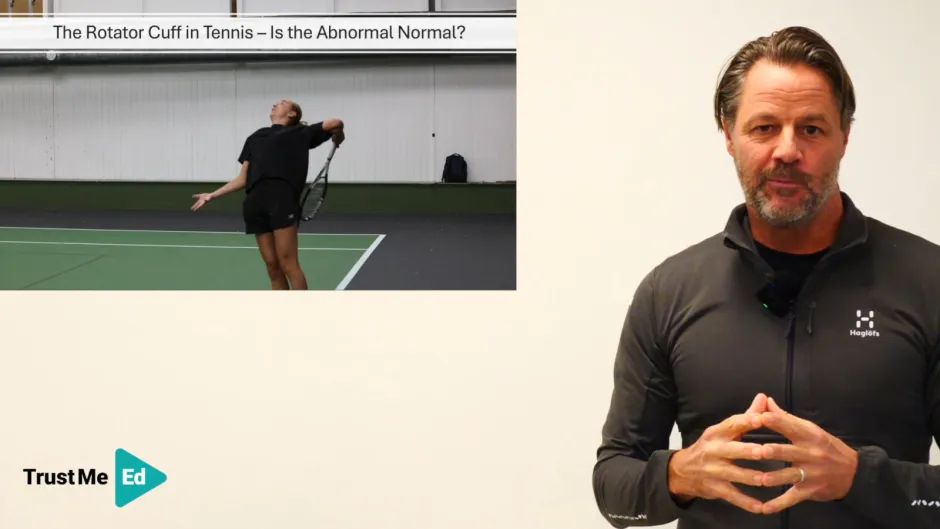
In this lecture, we aim to present and discuss if the abnormal is normal with regard to tennis from a prevention and/or performance point of view. It combines evidence-based knowledge with practical insights.
Learning Points
• Throwing mechanics needs to be practised early
• Sport-Specific Mechanics needs to be supported by strength
• Use slow-motion footage (video) to better understand the details
• Subscapularis is often in a fatigued muscular state
• Pectoralis minor needs to be assessed
How much load the tennis shoulder takes over a season, why injury patterns at elite level have not changed, and which abnormal findings, from infraspinatus atrophy to tendinosis on MRI, are common in players without symptoms.
Why infraspinatus strength acts as the brake of the serving arm, how to balance sport-specific and general shoulder training, why daily band work may be too much, and how to read rotation strength ratios.
How shoulder range of motion changes in throwing athletes, why humeral retrotorsion limits internal rotation, and how serve mechanics such as long axis rotation and shoulder lag affect load on the shoulder.
In this lecture, we aim to present and discuss if the abnormal is normal with regard to tennis from a prevention and/or performance point of view. It combines evidence-based knowledge with practical insights.
Learning Points
• Throwing mechanics needs to be practised early
• Sport-Specific Mechanics needs to be supported by strength
• Use slow-motion footage (video) to better understand the details
• Subscapularis is often in a fatigued muscular state
• Pectoralis minor needs to be assessed
We usually answer within a minute.
Ask anything about your membership, certificates or what is in the library.
No comments yet…