🍪 We use cookies
We use cookies to enhance your experience, analyze site traffic, and for marketing purposes. By clicking "Accept All", you consent to our use of cookies. Read our Privacy Policy


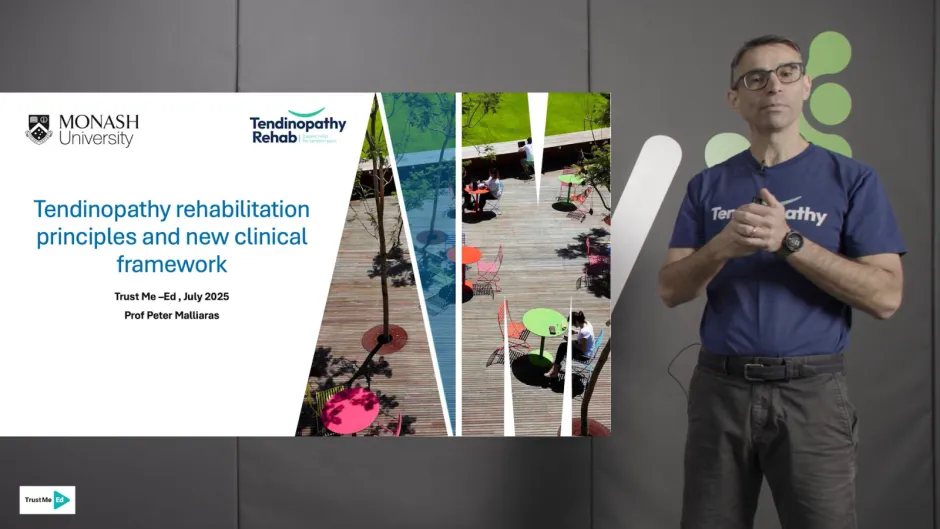
In this lecture, you will learn how to apply the latest evidence to design effective, patient-centered tendinopathy rehabilitation programs. It focuses on progressive loading principles, graded exposure, and targeted strength training, with an emphasis on building tolerance for meaningful activities rather than following rigid protocols. We will discuss how to combine isometric, isotonic, and eccentric exercises in a phased program, using clear criteria for progression. A key takeaway will be how to match exercise selection and loading parameters to the patient’s desired sport and capacity.
Learning outcomes
1. Explain the principles of progressive loading, graded exposure, and their role in tendinopathy rehabilitation.
2. Develop phased rehabilitation plans that integrate isometric, isotonic, and eccentric exercises based on patient needs.
3. Select and progress exercises according to patient capacity and the functional demands of their sport or activity.
What randomized trials show about exercise for tendinopathy pain, why one exercise type rarely beats another, and what recent Achilles guidelines and plantar fasciopathy trials suggest about advice and minimal intervention.
Why gains in strength and tendon stiffness do not explain pain improvement in tendinopathy, what mediation studies reveal about pain self-efficacy and catastrophizing, and why strength and stiffness still matter for function.
Rehabilitation as graded exposure within a strength and conditioning framework, a new three-stage model of capacity, force generation and absorption, and stretch shortening cycle work, and the wider role of isometrics.
Calf raise technique, endurance and strength targets for the Achilles, the dosage for each type of isometric and isotonic exercise, and how to schedule the program into a three-day maintenance week.
In this lecture, you will learn how to apply the latest evidence to design effective, patient-centered tendinopathy rehabilitation programs. It focuses on progressive loading principles, graded exposure, and targeted strength training, with an emphasis on building tolerance for meaningful activities rather than following rigid protocols. We will discuss how to combine isometric, isotonic, and eccentric exercises in a phased program, using clear criteria for progression. A key takeaway will be how to match exercise selection and loading parameters to the patient’s desired sport and capacity.
Learning outcomes
1. Explain the principles of progressive loading, graded exposure, and their role in tendinopathy rehabilitation.
2. Develop phased rehabilitation plans that integrate isometric, isotonic, and eccentric exercises based on patient needs.
3. Select and progress exercises according to patient capacity and the functional demands of their sport or activity.
We usually answer within a minute.
Ask anything about your membership, certificates or what is in the library.
No comments yet…