🍪 We use cookies
We use cookies to enhance your experience, analyze site traffic, and for marketing purposes. By clicking "Accept All", you consent to our use of cookies. Read our Privacy Policy


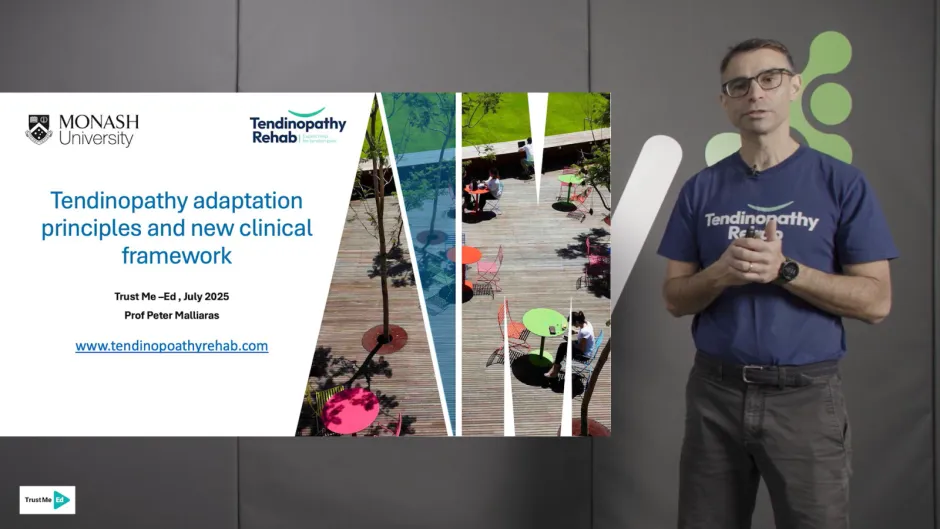
In this lecture you will learn how tendons adapt to load, what drives changes in stiffness, why strain thresholds are important, and how muscle–tendon unit properties influence performance and injury risk. We will cover the latest research on viscoelastic mechanisms, loading variables, and the time course of adaptation, and how these principles can be applied in clinical and performance settings. A key takeaway will be how to identify and use the optimal strain range (around 4.5–6.5 percent for Achilles) to design loading programs that build tendon capacity while minimising the risk of overload.
Learning outcomes
1. Describe the key factors that influence tendon stiffness and strain, and their implications for injury and performance.
2. Interpret current evidence on viscoelastic mechanisms and time course of tendon adaptation.
3. Apply optimal strain range principles to design safe and effective tendon loading strategies.
Whether a stiffer tendon is always better, how Achilles tendon stiffness is measured with ultrasound and a dynamometer, and which types of loading reliably build stiffness and how quickly the tendon adapts.
How the force velocity curve, joint position and moment arm shape tendon strain, and what research says about the minimum effective dose of isometric loading needed to stiffen a tendon without causing fatigue.
How the viscoelastic properties of tendon, fluid movement and stress relaxation contribute to adaptation, and a staged isometric progression from yielding holds through push isometrics and slow eccentrics to outer range pushes.
How to assess and progress Achilles isometrics in the clinic, from weighted holds in three ankle positions to seated and standing push tests on a force plate and pushes in full dorsiflexion.
A professional rugby player case shows the isometric progression in practice, followed by why MVIC is an unreliable guide to tendon strain and how to match training to mismatches between muscle strength and tendon stiffness.
In this lecture you will learn how tendons adapt to load, what drives changes in stiffness, why strain thresholds are important, and how muscle–tendon unit properties influence performance and injury risk. We will cover the latest research on viscoelastic mechanisms, loading variables, and the time course of adaptation, and how these principles can be applied in clinical and performance settings. A key takeaway will be how to identify and use the optimal strain range (around 4.5–6.5 percent for Achilles) to design loading programs that build tendon capacity while minimising the risk of overload.
Learning outcomes
1. Describe the key factors that influence tendon stiffness and strain, and their implications for injury and performance.
2. Interpret current evidence on viscoelastic mechanisms and time course of tendon adaptation.
3. Apply optimal strain range principles to design safe and effective tendon loading strategies.
We usually answer within a minute.
Ask anything about your membership, certificates or what is in the library.
No comments yet…