🍪 We use cookies
We use cookies to enhance your experience, analyze site traffic, and for marketing purposes. By clicking "Accept All", you consent to our use of cookies. Read our Privacy Policy


We start by discussing the different types of low-back-related leg pain. Then, we look more closely at the anatomy of the nerve roots and what's going on when they hurt and when they stop working. Next, we discuss the commonly seen but little-understood disc herniation. We then focus on two specific aspects of assessment: the differential diagnosis and diagnosing radicular pain. Finally, we look at ways to better help people with radicular pain, including key things to discuss, the role of exercise, and referring to other treatments.
- Understand what causes radicular pain and radiculopathy
- Understand what a disc herniation is
- Get better at talking to patients about sciatica
- Improve differential diagnosis of back and leg pain
- Understand the evidence behind the treatment of sciatica
You can find the resources folder HERE
Explore how nerve root anatomy explains sciatica and radicular pain, from the thecal sac and dorsal root ganglion to the cauda equina and intervertebral foramen. Learn how pressure, inflammation, and disrupted blood flow can trigger pain, weakness, numbness, and symptoms that don’t always follow textbook patterns.
Discover how spinal discs absorb force, what happens when bending makes them vulnerable, and why herniations can trigger radicular pain. You’ll also learn why bigger herniations aren’t always worse, and how the body often helps them heal over time.
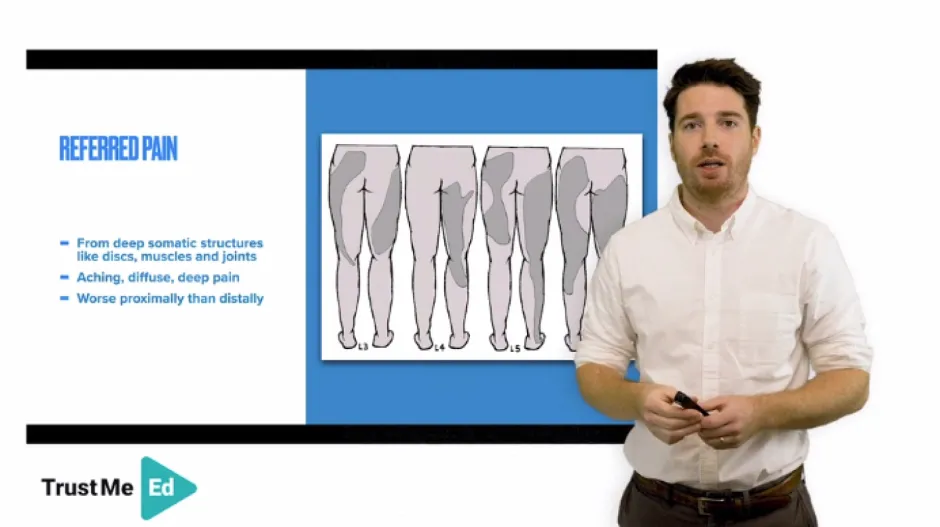
Untangle the confusing language around sciatica and learn what really separates referred pain, radicular pain, and radiculopathy. Guided by a physiotherapist with both personal and clinical experience, you’ll build a clearer picture of nerve root pain, disc involvement, and what these terms actually mean in practice.
Discover a practical, patient-centered approach to treating sciatica and radicular pain, from easing fear through clear explanations to choosing movement, exercise, and referral options wisely. Learn how validation, simple education, and timely decisions can make recovery feel more manageable and effective.
Learn how to sharpen your assessment of low back–related leg pain by distinguishing true spinal causes from key mimics like hip pathology, vascular disease, peripheral neuropathies, and endometriosis. You’ll also clarify how to weigh signs of radicular versus referred pain for more confident clinical decisions.
We start by discussing the different types of low-back-related leg pain. Then, we look more closely at the anatomy of the nerve roots and what's going on when they hurt and when they stop working. Next, we discuss the commonly seen but little-understood disc herniation. We then focus on two specific aspects of assessment: the differential diagnosis and diagnosing radicular pain. Finally, we look at ways to better help people with radicular pain, including key things to discuss, the role of exercise, and referring to other treatments.
- Understand what causes radicular pain and radiculopathy
- Understand what a disc herniation is
- Get better at talking to patients about sciatica
- Improve differential diagnosis of back and leg pain
- Understand the evidence behind the treatment of sciatica
You can find the resources folder HERE
We usually answer within a minute.
Ask anything about your membership, certificates or what is in the library.
No comments yet…