🍪 We use cookies
We use cookies to enhance your experience, analyze site traffic, and for marketing purposes. By clicking "Accept All", you consent to our use of cookies. Read our Privacy Policy


Anatomy and joint mechanics are ‘basics’ which are learnt by most practitioners at an early stage in their careers. Yet the Hand-Wrist region does not appear to be appropriately covered by most institutions, or alternatively a very simplistic approach is undertaken. Currently there is a lot of debate on whether diagnosis actually matters, and many believe that anatomy and mechanics do not really matter as we could likely approach many pathologies using a homogenous approach irrespective of structure. So…do structures matter? If truly anatomy and joint mechanics are basics, then why is it that no one appears to know them?
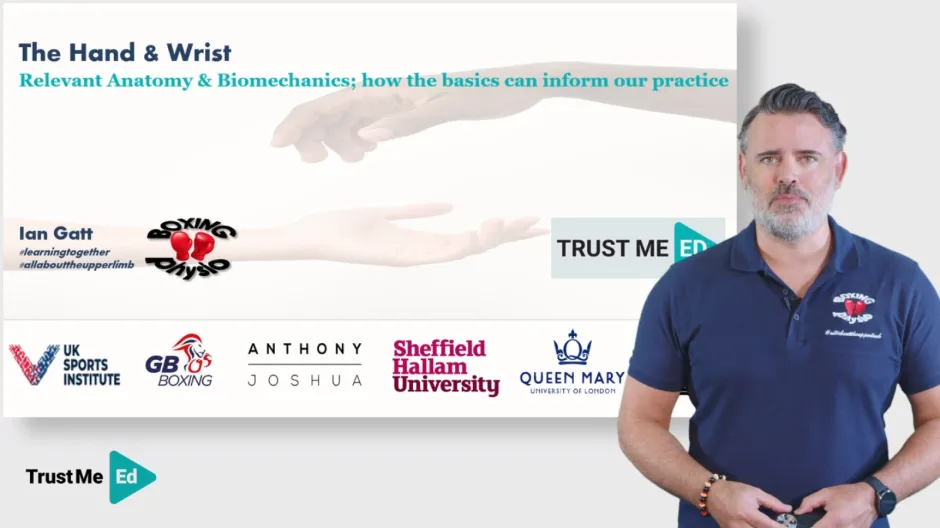
Join us for this educational content providing an overview of functional anatomy and biomechanics of the hand-wrist region. This module will provide a better understand of injury mechanics and assessment approaches. Further, we will discuss key areas to enable an enhanced approach towards rehab prescription.
The bones and joints of the hand and wrist, how the extensor and flexor tendons of the fingers are arranged, and how that anatomy guides the management of mallet finger, flexor tendon ruptures and climbing pulley injuries.
How sagittal band tears, CMC joint laxity and thumb UCL injuries arise in combat and ball sports, and how the midcarpal joint couples wrist extension with radial deviation in the dart throwing motion.
How to test the scapholunate ligament, how static and dynamic instability differ on imaging, why ulnar-sided wrist pain often has no clear pathology, and how to assess and load the TFCC.
The main muscles acting on the hand and wrist, a quick motor nerve screen, what makes a joint stable, and which muscles to favor or avoid when rehabilitating a scapholunate injury.
Anatomy and joint mechanics are ‘basics’ which are learnt by most practitioners at an early stage in their careers. Yet the Hand-Wrist region does not appear to be appropriately covered by most institutions, or alternatively a very simplistic approach is undertaken. Currently there is a lot of debate on whether diagnosis actually matters, and many believe that anatomy and mechanics do not really matter as we could likely approach many pathologies using a homogenous approach irrespective of structure. So…do structures matter? If truly anatomy and joint mechanics are basics, then why is it that no one appears to know them?
Join us for this educational content providing an overview of functional anatomy and biomechanics of the hand-wrist region. This module will provide a better understand of injury mechanics and assessment approaches. Further, we will discuss key areas to enable an enhanced approach towards rehab prescription.
We usually answer within a minute.
Ask anything about your membership, certificates or what is in the library.
No comments yet…