🍪 We use cookies
We use cookies to enhance your experience, analyze site traffic, and for marketing purposes. By clicking "Accept All", you consent to our use of cookies. Read our Privacy Policy


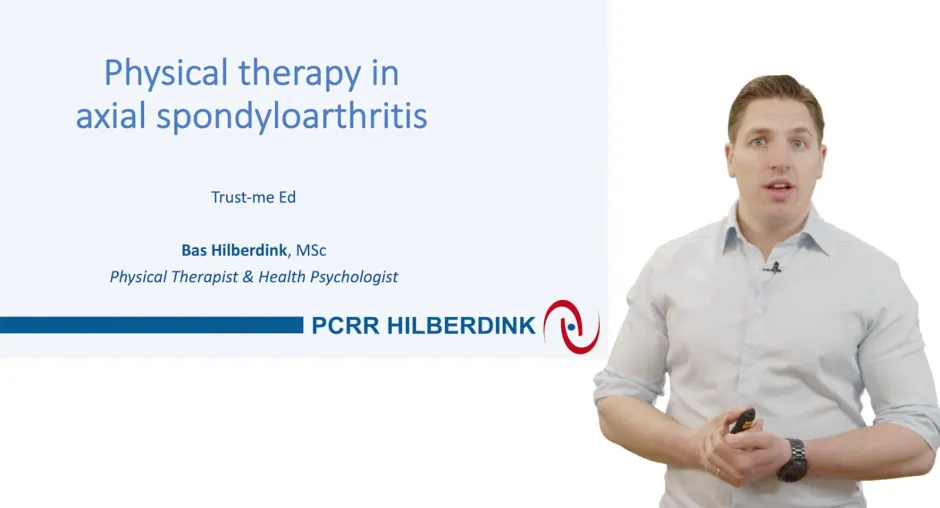
Axial spondyloarthritis (axSpA) is a chronic inflammatory rheumatic disease primarily affecting the spine and sacroiliac joints. The average time between symptom onset and diagnosis is seven years. Therefore, in this course you will first learn how to recognize axSpA, so you can refer someone with back problems (without diagnosis) and a suspicion of axSpA in time to a physician. Furthermore, recent studies have shown that the large majority of axSpA patients use physical therapy during the course of their disease, but also that the majority of treatments are not in line with recommendations for physical therapy in axSpA. Therefore, this course will largely focus on how to apply these recommendations, including the execution of an axSpA-specific physical assessments and exercise therapy. Finally, you will learn how to provide patient education on exercise activities and how to guide behavior change in axSpA patients.
Learning objectives:
· Disease information: Having knowledge on axSpA and being able to recognize its characteristics;
· Physical assessments: Being able to perform an axSpA-specific physical assessment;
· Treatment: Having an up-to-date knowledge on how to apply the recommended physical therapy treatment modalities in axSpA and being able to tailor a personal exercise program;
· Education: Having knowledge on adequate exercise advice for axSpA patients and being able to provide effective behavior change techniques in order to optimize exercise behavior.
How physical therapists can recognize axial spondyloarthritis early, using inflammatory back pain, related SpA features and the ASAS classification criteria, and what the ASAS-EULAR recommendations say about drug and non-drug management.
Choosing assessments for people with axial spondyloarthritis by their needs, with demonstrations and norm values for five ASAS spinal mobility tests and the three timed tasks of the ASPI performance test.
Exercise therapy for axial spondyloarthritis: recommended doses for mobility, strength, aerobic and neuromotor training, example exercises, six combined movements that train several qualities at once, and how to scale them using pain responses.
How to educate people with axial spondyloarthritis about the disease, physical activity and sports choices, and how to support lasting exercise behavior with change talk, guided practice and action planning.
Axial spondyloarthritis (axSpA) is a chronic inflammatory rheumatic disease primarily affecting the spine and sacroiliac joints. The average time between symptom onset and diagnosis is seven years. Therefore, in this course you will first learn how to recognize axSpA, so you can refer someone with back problems (without diagnosis) and a suspicion of axSpA in time to a physician. Furthermore, recent studies have shown that the large majority of axSpA patients use physical therapy during the course of their disease, but also that the majority of treatments are not in line with recommendations for physical therapy in axSpA. Therefore, this course will largely focus on how to apply these recommendations, including the execution of an axSpA-specific physical assessments and exercise therapy. Finally, you will learn how to provide patient education on exercise activities and how to guide behavior change in axSpA patients.
Learning objectives:
· Disease information: Having knowledge on axSpA and being able to recognize its characteristics;
· Physical assessments: Being able to perform an axSpA-specific physical assessment;
· Treatment: Having an up-to-date knowledge on how to apply the recommended physical therapy treatment modalities in axSpA and being able to tailor a personal exercise program;
· Education: Having knowledge on adequate exercise advice for axSpA patients and being able to provide effective behavior change techniques in order to optimize exercise behavior.
We usually answer within a minute.
Ask anything about your membership, certificates or what is in the library.
No comments yet…