🍪 We use cookies
We use cookies to enhance your experience, analyze site traffic, and for marketing purposes. By clicking "Accept All", you consent to our use of cookies. Read our Privacy Policy


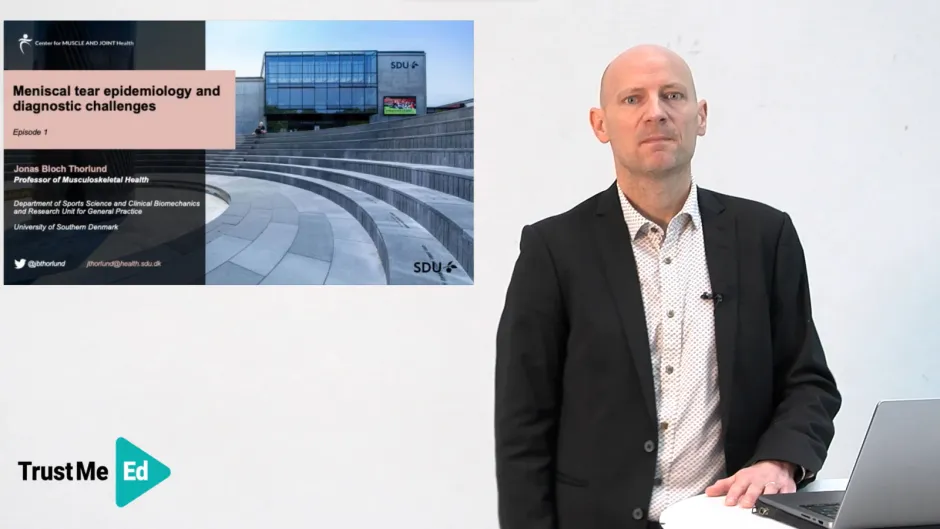
The first lecture sets the scene with a short epidemiological section and discussion of the clinical challenges of diagnosing a meniscal tear.
In episodes 2 and 3 the current evidence for management of middle-aged and older patients with degenerative meniscal tears (episode 2) and management of young active patients with meniscal tears is discussed. In both episodes 2 and 3 the existence of potential sub-groups of patients with suggested larger benefit of treatments is also discussed.
Explore what the evidence really shows for managing degenerative meniscal tears in middle-aged and older adults, and why exercise often matches surgery for pain and function. You’ll also learn why mechanical symptoms may be misleading and how realistic recovery expectations can shape better treatment decisions.
Discover what current research reveals about treating meniscal tears in young, active adults: early surgery doesn’t appear to outperform exercise therapy, and many can improve without an operation. You’ll also learn when surgery may still make more sense, especially for persistent mechanical symptoms.
Explore why meniscal tears are among the most common knee injuries, how they raise the risk of osteoarthritis, and why diagnosis is often more complicated than it seems. Learn the key differences between traumatic and degenerative tears, the limits of clinical tests and MRI, and what really matters when assessing symptoms.
The first lecture sets the scene with a short epidemiological section and discussion of the clinical challenges of diagnosing a meniscal tear.
In episodes 2 and 3 the current evidence for management of middle-aged and older patients with degenerative meniscal tears (episode 2) and management of young active patients with meniscal tears is discussed. In both episodes 2 and 3 the existence of potential sub-groups of patients with suggested larger benefit of treatments is also discussed.
We usually answer within a minute.
Ask anything about your membership, certificates or what is in the library.
No comments yet…