🍪 We use cookies
We use cookies to enhance your experience, analyze site traffic, and for marketing purposes. By clicking "Accept All", you consent to our use of cookies. Read our Privacy Policy


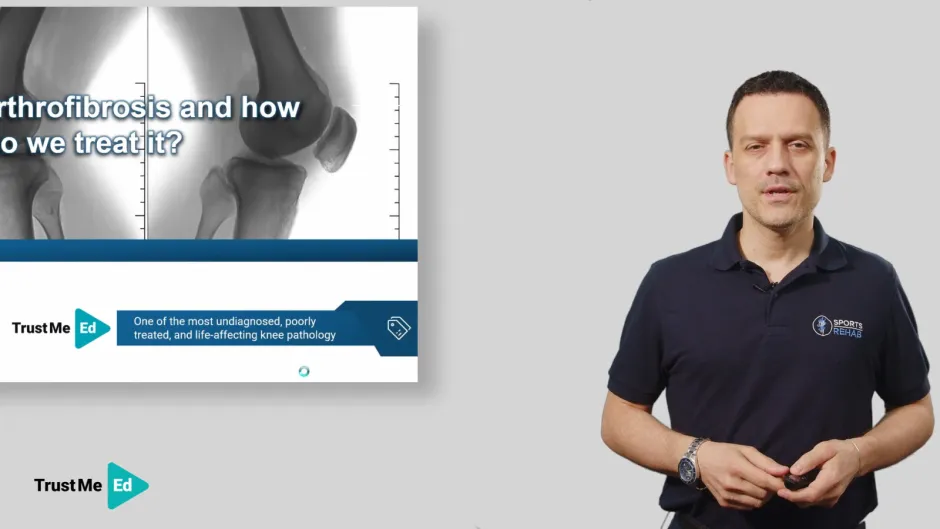
Knee arthrofibrosis (KAF) is an orthopedic complication that can occur following injury or surgery (even minor procedures, such as a partial meniscectomy) in which an exaggerated and uncontrolled inflammatory response leads to excessive and abnormal scar tissue formation, then painful restriction of joint range of motion (ROM).
This clinical condition can then evolve into muscle atrophy, patellar tendon shortening, and localized or generalized scarring inside and outside the knee joint, thus involving the entire joint capsule, which thickens generating a state of hyper-compression and patellar hypo-mobility. The patellar tendon tends to shorten and the Hoffa's fat pad body, which often becomes "sticky" and adherent to the back of the patellar tendon itself, pulls the latter towards the center of the knee causing a patella baya (inferior) condition. A series of anatomical changes typical of the pathology are then established. The combination of these factors in the most severe cases of knee arthrofibrosis compresses the entire joint, which becomes rigid with loss of flexion-extension (which varies greatly from case to case) and with potentially minimal or absent patellar mobility. Lack of full extension and patella baya can eventually generate damage to the articular cartilage.
This condition is almost unknown to surgeons and physical therapists due to an actual vulnus in undergraduate training and in the postgraduate specialization courses for both the health professions.
Highly specialized rehabilitation is always the first approach that is therefore essential.
Multidisciplinarity is crucial in this complicated process, which is why the instructor works closely with a specialized team of orthopedic knee surgeons in Switzerland on the clinical side, as well as with some specialists in Switzerland, United States, and Australia on research projects to best manage each case of KAF.
LEARNING OBJECTIVES
- Develop the skills to early diagnose KAF
- Understanding how to become a 1st level expert for KAF patients, able to offer immediate support with specialized programs, ensuring the best chance of recovery
- Have clear priorities, depending on the severity of the individual case, in the specialized rehabilitation of KAF
- Get to know the devices that support the rehabilitation of KAF
- Have an up-to-date view of the evolving scientific literature regarding KAF
This lecture on knee arthrofibrosis will provide the attendees with evidence- and expertise-based foundation, diagnosis schemes, and fully practical treatment guidelines covering the clinical presentation of this complex orthopaedic pathology.
Why knee arthrofibrosis is so often missed or misdiagnosed, the team approach used at a specialized center, and what the published data say about how often stiff knees occur after surgery.
What happens inside a knee with arthrofibrosis, from the inflammatory loop and fibroblast-to-myofibroblast change to the primary and secondary drivers such as immobilization, bleeding, hypoxia, fat pad sensitization and aggressive physiotherapy.
How to recognize knee arthrofibrosis early, which injuries carry the highest risk, where scar tissue forms, the difference between active and residual stages, the clinical signs and patellar changes, and how severity is graded.
Which conditions to rule out before diagnosing knee arthrofibrosis, including cyclops lesion, ACL graft malposition, graft flaps, CRPS, infection and implant loosening, and the IAA pathway for active and residual cases.
The little and often physiotherapy program for knee arthrofibrosis, with low-load prolonged stretching for extension, patellar mobilization, heel slides, quadriceps stretching, ice and compression, load management and support for patients and families.
When to refer a patient with knee arthrofibrosis to a specialized surgeon, why manipulation under anesthesia is discouraged, what careful arthroscopic release involves, and how rehabilitation runs after surgery.
Knee arthrofibrosis (KAF) is an orthopedic complication that can occur following injury or surgery (even minor procedures, such as a partial meniscectomy) in which an exaggerated and uncontrolled inflammatory response leads to excessive and abnormal scar tissue formation, then painful restriction of joint range of motion (ROM).
This clinical condition can then evolve into muscle atrophy, patellar tendon shortening, and localized or generalized scarring inside and outside the knee joint, thus involving the entire joint capsule, which thickens generating a state of hyper-compression and patellar hypo-mobility. The patellar tendon tends to shorten and the Hoffa's fat pad body, which often becomes "sticky" and adherent to the back of the patellar tendon itself, pulls the latter towards the center of the knee causing a patella baya (inferior) condition. A series of anatomical changes typical of the pathology are then established. The combination of these factors in the most severe cases of knee arthrofibrosis compresses the entire joint, which becomes rigid with loss of flexion-extension (which varies greatly from case to case) and with potentially minimal or absent patellar mobility. Lack of full extension and patella baya can eventually generate damage to the articular cartilage.
This condition is almost unknown to surgeons and physical therapists due to an actual vulnus in undergraduate training and in the postgraduate specialization courses for both the health professions.
Highly specialized rehabilitation is always the first approach that is therefore essential.
Multidisciplinarity is crucial in this complicated process, which is why the instructor works closely with a specialized team of orthopedic knee surgeons in Switzerland on the clinical side, as well as with some specialists in Switzerland, United States, and Australia on research projects to best manage each case of KAF.
LEARNING OBJECTIVES
- Develop the skills to early diagnose KAF
- Understanding how to become a 1st level expert for KAF patients, able to offer immediate support with specialized programs, ensuring the best chance of recovery
- Have clear priorities, depending on the severity of the individual case, in the specialized rehabilitation of KAF
- Get to know the devices that support the rehabilitation of KAF
- Have an up-to-date view of the evolving scientific literature regarding KAF
This lecture on knee arthrofibrosis will provide the attendees with evidence- and expertise-based foundation, diagnosis schemes, and fully practical treatment guidelines covering the clinical presentation of this complex orthopaedic pathology.
We usually answer within a minute.
Ask anything about your membership, certificates or what is in the library.
No comments yet…