🍪 We use cookies
We use cookies to enhance your experience, analyze site traffic, and for marketing purposes. By clicking "Accept All", you consent to our use of cookies. Read our Privacy Policy


Description:
This lecture will provide up-to-date evidence for the cause, prevention, and management of hamstring strain injuries (HSI). The hamstrings are the most commonly injured muscle group among athletes who sprint regularly and thus represent a particular burden in sports such as football, soccer, and track. The high rate of injury recurrence suggests that evaluation and treatment of HSI can be improved with a more complete understanding of the injury risk factors and the subsequent structural, neuromuscular, and biomechanical effects of injury.
This lecture will review the biomechanics of the hamstring muscles during sprinting and factors associated with injury, as well as the persistent morphological and functional deficits that contribute to re-injury risk. Scientifically-supported approaches to injury assessment and rehabilitation will be demonstrated, including proper exercise selection and progression.
Learning Objectives:
Upon completion of this lecture, participants will be able to:
1. Explain the biomechanical demands placed on the hamstrings during high-speed running.
2. Identify common morphological and functional deficits that remain long-term following a hamstring strain injury.
3. Describe an evidence-based rehabilitation program and return-to-sport progression that minimizes re-injury risk.
Why terminal swing is the likely moment of running-related hamstring strain, how hamstring load rises with sprint speed, and what the evidence says about eccentric training for preventing injury and screening athletes at risk.
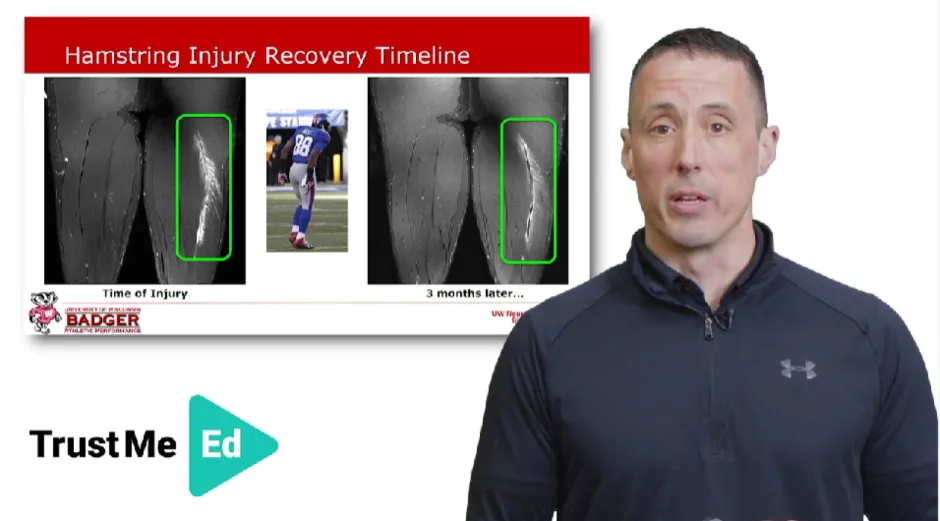
What changes in the hamstring after a strain, from lasting scar tissue and atrophy to strength deficits at long muscle lengths, and how to examine an acute injury to judge its severity and starting point for rehab.
A three-phase rehabilitation plan for hamstring strain built on eccentric loading, a running speed progression and lumbopelvic control, with example exercises, criteria for moving between phases and the measures used to judge return to play.
Description:
This lecture will provide up-to-date evidence for the cause, prevention, and management of hamstring strain injuries (HSI). The hamstrings are the most commonly injured muscle group among athletes who sprint regularly and thus represent a particular burden in sports such as football, soccer, and track. The high rate of injury recurrence suggests that evaluation and treatment of HSI can be improved with a more complete understanding of the injury risk factors and the subsequent structural, neuromuscular, and biomechanical effects of injury.
This lecture will review the biomechanics of the hamstring muscles during sprinting and factors associated with injury, as well as the persistent morphological and functional deficits that contribute to re-injury risk. Scientifically-supported approaches to injury assessment and rehabilitation will be demonstrated, including proper exercise selection and progression.
Learning Objectives:
Upon completion of this lecture, participants will be able to:
1. Explain the biomechanical demands placed on the hamstrings during high-speed running.
2. Identify common morphological and functional deficits that remain long-term following a hamstring strain injury.
3. Describe an evidence-based rehabilitation program and return-to-sport progression that minimizes re-injury risk.
We usually answer within a minute.
Ask anything about your membership, certificates or what is in the library.
No comments yet…