🍪 We use cookies
We use cookies to enhance your experience, analyze site traffic, and for marketing purposes. By clicking "Accept All", you consent to our use of cookies. Read our Privacy Policy


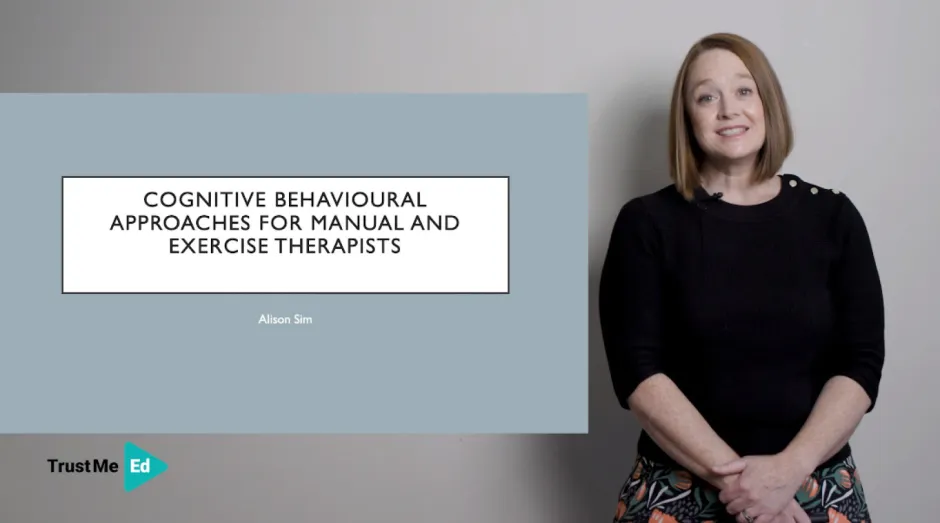
This lecture will cover the theories that lie within cognitive behavioural therapy (CBT), a well known psychological framework for understanding and challenging unhelpful beliefs. As manual and exercise therapists we are frequently faced with clients presenting with beliefs that are either unhelpful or don’t fit with a modern pain science understanding. We explore the communication strategies that can be helpful for practitioners to review client’s thoughts and emotions that are related to their pain presentation. This is not about stepping outside of our scope to delve into psychology, but to enhance and improve some of the conversations that we will already be having around how a clients views their pain.
Learning points
* Understand the basic theories behind CBT
* To review strategies that can help enhance conversations about pain and function.
Why the therapeutic alliance drives outcomes in manual and exercise therapy, how emotional distress predicts poor recovery and chronic pain, and which listening skills help build a strong connection with distressed patients.
What the evidence shows for cognitive behavioral therapy in pain, how physical therapists can use a psychologically informed approach within their scope, and how the thoughts, emotions and behavior triangle explains fear avoidance.
How to draw out a patient's worrying thoughts with open questions, spot common cognitive distortions, weigh the evidence for and against those thoughts together, and use the six-column thought record for structure.
A worked case of a distressed patient with a low back pain flare-up, showing how to label emotions, validate the experience, uncover worries with open questions and build more helpful thoughts using her own past evidence.
This lecture will cover the theories that lie within cognitive behavioural therapy (CBT), a well known psychological framework for understanding and challenging unhelpful beliefs. As manual and exercise therapists we are frequently faced with clients presenting with beliefs that are either unhelpful or don’t fit with a modern pain science understanding. We explore the communication strategies that can be helpful for practitioners to review client’s thoughts and emotions that are related to their pain presentation. This is not about stepping outside of our scope to delve into psychology, but to enhance and improve some of the conversations that we will already be having around how a clients views their pain.
Learning points
* Understand the basic theories behind CBT
* To review strategies that can help enhance conversations about pain and function.
We usually answer within a minute.
Ask anything about your membership, certificates or what is in the library.
No comments yet…