🍪 We use cookies
We use cookies to enhance your experience, analyze site traffic, and for marketing purposes. By clicking "Accept All", you consent to our use of cookies. Read our Privacy Policy


After section 1, the learner will:
1. Have an improved appreciation of exercise
2. Understand the meaning of "effect size" as related to interventions
3. Understand the what evidence we know and do not know about exercise
4. Begin to see the need to develop your exercise specialization
After section 2, the learner will:
1. Understand the concept of mechanotransduction
2. Discuss therapeutic alliance
3. Appreciate the value of a true partnership
4. Be able to lay the foundation for an effective and efficient exercise program
5. Further appreciate the need to develop your exercise specialization
After section 3, the learner will:
1. Recognize different exercise paradigms
2. Begin to apply one or more exercise paradigms
3. Reflect on the complexity of humans and the need for exercise specialization
After section 4, the learner will:
1. Become familiar with Paradigm Ex
2. Apply Paradigm Ex
3. Identify missing components of your own exercise prescription
After section 5, the learner will:
1. Become familiar with the evidence that supports Paradigm Ex
2. Understand Paradigm Ex in greater detail
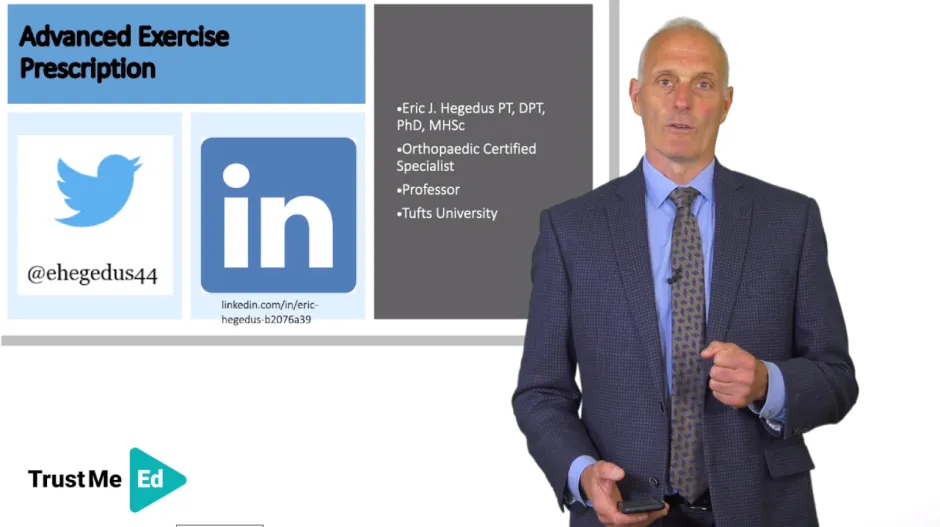
Thanks to Drayer Physical Therapy Institute for allowing us to film Eric's lectures in their clinic.
Discover a practical, evidence-informed framework for prescribing exercise that goes far beyond sets and reps. You’ll learn how to think from local to global effects, organize training goals more clearly, and tailor rehabilitation or performance progressions with greater purpose.
Discover the foundational principles behind effective exercise prescription, from how mechanical loading drives tissue adaptation to how patient goals, motivation, and therapeutic alliance shape better outcomes. Learn how to design smarter, more individualized programs that truly support lasting change.
Explore how exercise prescription evolves when you move beyond vague ideas of “strength” and start distinguishing activation, motor control, power, plyometrics, and cardiorespiratory fitness. You’ll learn to compare major exercise paradigms and rethink how to build smarter, more patient-centered programs.
Rethink exercise prescription as a powerful, individualized skill that goes far beyond pain relief, range of motion, and generic handouts. Discover why creativity, complexity, and smarter clinical reasoning can lead to better outcomes—and why patients may finally follow through.
Discover how advanced exercise prescription moves beyond simple strengthening to build smarter, more effective rehab from local muscle activation to whole-body performance. Learn how eccentrics, motor control, patient-centered strategies, and real-world progressions can improve recovery, confidence, and long-term adherence.
Discover how advanced exercise prescription comes to life through real case studies, from runners with knee pain to patients recovering function after surgery or chronic back issues. Learn to build smarter progressions, adapt to individual goals, and apply evidence-informed strategies that make rehabilitation more effective and practical.
Discover how expert clinicians think beyond special tests, using history, prevalence, clinical reasoning, and patient partnership to make better decisions. You’ll also learn why self-efficacy, therapeutic alliance, and smarter exercise progressions can transform outcomes far more than rigid protocols.
After section 1, the learner will:
1. Have an improved appreciation of exercise
2. Understand the meaning of "effect size" as related to interventions
3. Understand the what evidence we know and do not know about exercise
4. Begin to see the need to develop your exercise specialization
After section 2, the learner will:
1. Understand the concept of mechanotransduction
2. Discuss therapeutic alliance
3. Appreciate the value of a true partnership
4. Be able to lay the foundation for an effective and efficient exercise program
5. Further appreciate the need to develop your exercise specialization
After section 3, the learner will:
1. Recognize different exercise paradigms
2. Begin to apply one or more exercise paradigms
3. Reflect on the complexity of humans and the need for exercise specialization
After section 4, the learner will:
1. Become familiar with Paradigm Ex
2. Apply Paradigm Ex
3. Identify missing components of your own exercise prescription
After section 5, the learner will:
1. Become familiar with the evidence that supports Paradigm Ex
2. Understand Paradigm Ex in greater detail
Thanks to Drayer Physical Therapy Institute for allowing us to film Eric's lectures in their clinic.
We usually answer within a minute.
Ask anything about your membership, certificates or what is in the library.
No comments yet…