🍪 We use cookies
We use cookies to enhance your experience, analyze site traffic, and for marketing purposes. By clicking "Accept All", you consent to our use of cookies. Read our Privacy Policy


Description of the Lecture:
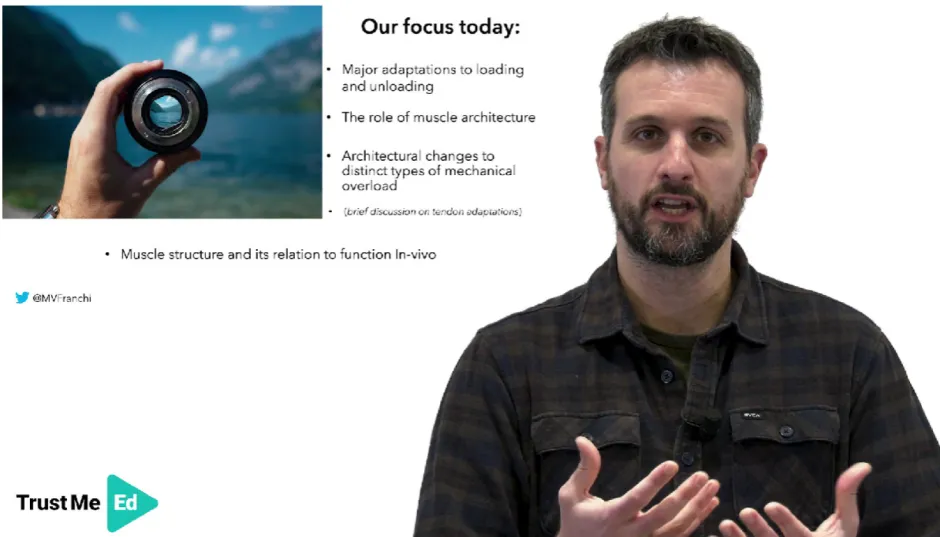
In the present Lecture, the key concepts of adaptations in muscle morphology and architecture to exercise and muscle disuse will be presented. Such adaptive strategies will be discussed in relation to how they may affect muscle performance and its functional properties. Specifically, the adaptations of muscle (and tendon) tissue to distinct mechanical stimuli will be presented.
Learning points:
-Muscle is highly plastic, and it remodels itself in response to loading, ageing and disuse.
-Muscle structure appears to change differently in response ti distinct contraction typologies
-The relationship between muscle function and architecture is still not fully understood, as the muscle-tendon unit is a complex system and the MTU remodelling affects not only muscle tissue, but connective structures and series elastic components. However, understanding about muscle structure is a great tool for understanding muscle mechanics during performance and rehabilitation.
How quickly skeletal muscle and tendon change in size and structure with resistance training, immobilization, bed rest and training cessation, and why short breaks from training deserve more attention in sport.
What muscle architecture is and how to measure it with ultrasound, how fascicle length and pennation angle shape force production, and how eccentric and concentric training remodel muscle in different ways.
Why the patellar tendon responds the same to eccentric and concentric training, how muscle architecture links to function in living people, and what a Nordic hamstring study revealed about sarcomere length.
Description of the Lecture:
In the present Lecture, the key concepts of adaptations in muscle morphology and architecture to exercise and muscle disuse will be presented. Such adaptive strategies will be discussed in relation to how they may affect muscle performance and its functional properties. Specifically, the adaptations of muscle (and tendon) tissue to distinct mechanical stimuli will be presented.
Learning points:
-Muscle is highly plastic, and it remodels itself in response to loading, ageing and disuse.
-Muscle structure appears to change differently in response ti distinct contraction typologies
-The relationship between muscle function and architecture is still not fully understood, as the muscle-tendon unit is a complex system and the MTU remodelling affects not only muscle tissue, but connective structures and series elastic components. However, understanding about muscle structure is a great tool for understanding muscle mechanics during performance and rehabilitation.
We usually answer within a minute.
Ask anything about your membership, certificates or what is in the library.
No comments yet…