🍪 We use cookies
We use cookies to enhance your experience, analyze site traffic, and for marketing purposes. By clicking "Accept All", you consent to our use of cookies. Read our Privacy Policy


This lecture described the fundamental principles of Achilles tendinopathy assessment. This is achieved through the perspective of Achilles tendon structure and function relationships and current understanding of pain and pathophysiology. The exercise evidence base is succinctly synthesised prior to step-by-step discussion of key characteristics of a successful rehabilitation and education program for this condition.
-Learning points
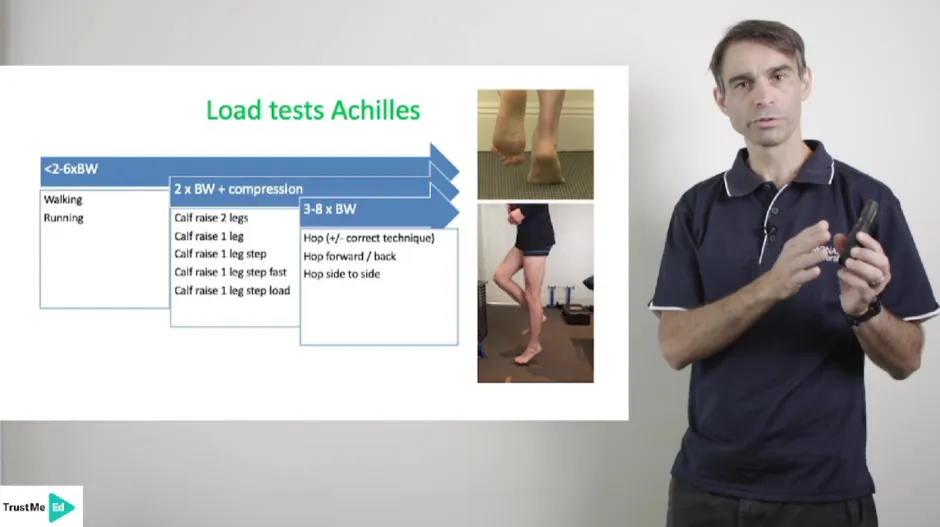
How to assess load tolerance in Achilles tendinopathy with graded clinic load tests, what level of pain is acceptable during loading, and how to tell midportion tendinopathy apart from paratenon, plantaris, sural nerve and other differentials.
Why the Achilles is the body's main energy storage tendon, how its structure and the muscle working near isometrically make movement efficient, and why heavy slow loading adapts the tendon while hopping mainly builds power.
Clinical tests of calf capacity in Achilles tendinopathy: standing single-leg calf raise endurance with age norms, the seated calf raise eight-repetition maximum, and hopping assessed through contact time, flight time and force plate data.
A staged exercise plan for Achilles tendinopathy that moves from isometrics through strength-endurance and maximal strength to strength-speed, with sets, repetitions, rest ratios, load targets and the OMNI scale for each phase.
When and how to add a graded hopping program to Achilles rehab, how to reduce stretch-shortening cycle load during a flare, and what education helps build working alliance, self-efficacy and realistic expectations.
This lecture described the fundamental principles of Achilles tendinopathy assessment. This is achieved through the perspective of Achilles tendon structure and function relationships and current understanding of pain and pathophysiology. The exercise evidence base is succinctly synthesised prior to step-by-step discussion of key characteristics of a successful rehabilitation and education program for this condition.
-Learning points
We usually answer within a minute.
Ask anything about your membership, certificates or what is in the library.
No comments yet…